
Dear Friends,
As we approach Lag Ba’Omer—a time of light, connection, and renewed hope—I’m pleased to introduce this new edition of our newsletter. It is our aim to keep you informed and inspired with updates from around the world.
In this issue, we are particularly excited to share news of the recent international conference on hysteroscopy in Barcelona. This event brought together leading experts in the field and provided a valuable platform for advancing medical knowledge.
At Tahareinu, we are privileged to stand at the intersection of Torah values and cutting-edge medicine. The innovations presented at the conference—especially those offering better diagnostic and fertility care—reinforce our mission: to empower individuals with knowledge and compassion rooted in both halacha and the highest medical standards. May this Lag BaOmer kindle in us all a renewed commitment to bringing light, health, and hope to our communities.
Warm regards,
Rabbi Yitzchok Melber

Embracing the Revolution: “The Power of Hysteroscopy”
Game-changing insights for Women’s Health and Taharas Hamishpacha
From the Global Congress on Hysteroscopy

“No woman should suffer in silence”
Tahareinu’s mission
A Medical Frontier of its Own
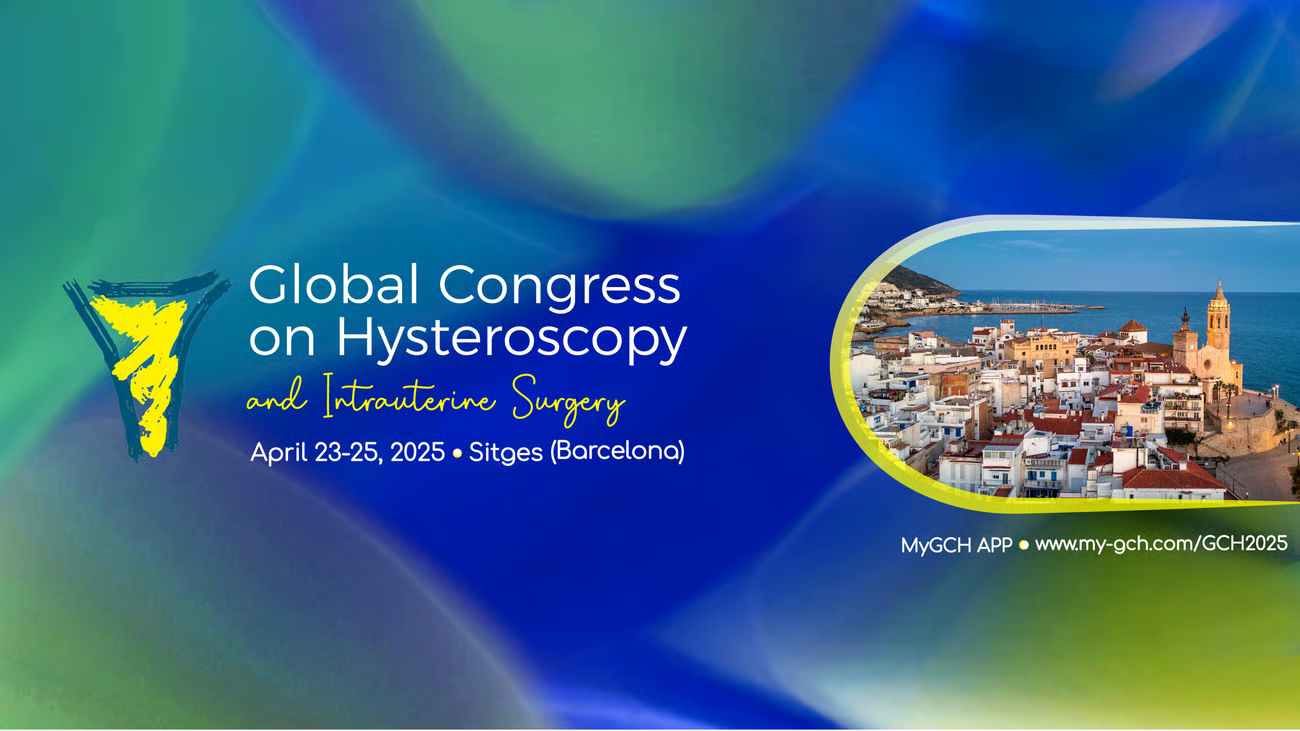
At the recent Global Congress on Hysteroscopy, attended by Rabbi Melber, a great range of innovations was presented — and we are pleased to share these insights with you.
More than 100 state-of-the-art devices and systems were on display — each representing a significant advancement in women’s healthcare.
Hysteroscopy is not merely a tool — it represents a transformative shift in gynecological care.
What is hysteroscopy?
Hysteroscopy is a minimally invasive procedure in which a slender instrument equipped with a camera is inserted through the cervix to visualize the uterine cavity. It enables both diagnosis and treatment of intrauterine conditions — without incisions, often without anesthesia, and typically without hospitalization.
Previously, diagnosing or managing uterine abnormalities often required major surgery or relied on less accurate imaging methods such as ultrasound or MRI. Hysteroscopy allows physicians to view the uterine environment in real time — with exceptional clarity — and to address issues immediately.
To illustrate:
It’s the difference between looking through a window – and stepping into the room.
However, three major barriers currently limit access to hysteroscopy:
- An estimated 90% of gynecologists are unfamiliar with hysteroscopy; only 5% regularly utilize it.
- Among those who do, many still rely on outdated equipment.
- Fewer than 1% of Rabbonim are aware of the procedure, and public awareness is even lower.
At Tahareinu, this innovation holds particular relevance. Hysteroscopy has the potential to profoundly improve the Tahara experience for thousands of women affected by abnormal uterine bleeding (AUB) and related conditions.
Why it Matters for Tahara
Hysteroscopy is particularly useful in evaluating irregular bleeding, including:
- Heavy or prolonged periods
- Mid-cycle bleeding
- Persistent staining that delays mikvah
Even relatively minor AUB can disrupt the rhythm of family life and kedusha. The emotional burden can be substantial: anxiety, uncertainty, and repeated disappointment. Women await for 7 clean days, often unsure if they will get to Mikva. Some women wait months without resolution.
Thanks to hysteroscopy, it is now possible to identify and treat over 90% of AUB causes — accurately, promptly, and often in a single visit. No more guesswork. No more waiting. No more hoping it will fix itself.
One important takeaway from the Congress: Women over age 40 — particularly those susceptible to structural defects such as polyps or fibroids — should seek physicians who offer hysteroscopy. Early intervention prevents complications.
This recommendation also applies to younger women – for instance:
Following a miscarriage, a traditional D&C may leave residual tissue that causes ongoing issues affecting both tahara and fertility.
If ultrasound reveals retained products of conception, the appropriate next step is hysteroscopy for accurate removal.
Side effect: HOPE
Hysteroscopy enables rapid, precise treatment with minimal discomfort. Many procedures take only minutes and do not require a speculum or anesthesia.
This is not conventional surgery — it is targeted, high-precision therapy.
Tahareinu is committed to empowering women with accurate medical information, connecting them with top-tier providers, and advancing the conversation in both the medical and halachic spheres.
– this is the future of Taharas Hamishpacha.
Common AUB Conditions Diagnosed with Hysteroscopy
- Polyps: Benign growths within the uterus; may cause bleeding; occasionally precancerous
- Fibroids: Non-cancerous tumors common in women over 40
- Adhesions/Asherman’s: Scar tissue within the uterus that may obstruct or distort the cavity
- Retained Products of Conception: Placental or fetal tissue remaining after miscarriage or childbirth
- Adenomyosis: Invasion of endometrial tissue into the muscular uterine wall
- Cancer/Hyperplasia: Abnormal or precancerous cell growth
- Chronic Endometritis: Persistent inflammation of the uterine lining, often undiagnosed
- Unhealthy Lining: Thickened lining with impaired function.
FAQ: What Every Woman Should Know:
Q: Will my regular gynecologist recommend hysteroscopy?
A: Probably not. Only 5% of gynecologists worldwide are trained in this sub-specialty and it is not widely included in standard medical education.
Q: Where can I get more information?
A: Call Tahareinu’s hotline or search for a hysteroscopy-trained expert in your city. Don’t settle and don’t hesitate to seek second opinions.
Q: Is it expensive?
A: In the U.S., Canada, Israel, and Belgium, it’s often public or affordable.
In the UK, this is available under the NHS but there may be long waiting lists. It is available privately but is generally more expensive than doing privately in other European countries and Israel. Some women may choose to travel.
Q: Is it painful or invasive?
A: Some experience mild discomfort, most of the time it won’t be painful – and it takes only a few minutes.
When being done for diagnosis or minimal treatment, the hysteroscopy generally won’t need anesthesia, and occasionally done with local anesthesia. In the UK, many clinics will always use local anesthetic.
When a more complicated treatment, it will be either local or general anesthetic.
Q: Can a bodekes tahara diagnose these issues?
A: No. A nurse doing an external exam can only visualize the cervix. Polyps, fibroids, and other uterine issues are internal and remain invisible, requiring imaging or hysteroscopy to detect.
Medical Foundations
The conference emphasized using the PALM-COEIN system to classify AUB causes:
PALM (Structural):
- Polyp
- Adenomyosis
- Leiomyoma (Fibroid)
- Malignancy/Hyperplasia
COEIN (Non-structural):
- Coagulopathy
- Ovulatory dysfunction
- Endometrial issues
- Iatrogenic (medication-induced)
- Not otherwise classified
Hysteroscopy is a fantastic tool for diagnosing and treating structural causes. Even in some non-structural cases, hysteroscopy can visualize and confirm causes far better than ultrasound, particularly in chronic endometriosis.
Halachic Guidance: Questions to ask and report to your Rav
- How big was the device? (Most are under 3mm—generally acceptable.)
- Was the cervix dilated? (Often unnecessary.)
- Was it diagnostic or treatment? (Halacha may differ. If it was diagnostic, there was likely no bleeding. If there was treatment, it depends on what was done.)
If there was bleeding, ask the doctor if it was from the cervix or uterus. This helps determine if it affects tahara status.
Our message is clear:
Don’t wait! Don’t settle! Don’t assume it’s “just your body!”
If you have AUB or recurring staining, hysteroscopy might be the definitive answer.


